Understanding Air Quality Challenges in Textile Factories
Textile manufacturing environments generate a complex mix of airborne contaminants that can affect both product quality and the working environment. Addressing these challenges typically begins with understanding what is present in the air and how fresh air filtration contributes to indoor air quality management.
Common Airborne Contaminants in Textile Production
Airborne contaminants in textile production generally fall into several categories. Fibre dust and cotton dust are released during opening, carding, combing, spinning, and weaving operations. Fly lint and loose fibres become airborne as yarns and fabrics move through machinery at speed. Oil mist may be generated by high-speed spindles, bearings, and other lubricated components. In addition, temperature and humidity fluctuations can influence how particles behave and how comfortable the indoor environment remains.
The concentration and composition of these contaminants vary with the fibre type, process stage, machinery condition, and the effectiveness of local exhaust and general ventilation. Because these particles can remain suspended for extended periods, a structured approach to air handling and filtration is generally necessary to maintain acceptable conditions.
Why Fresh Air Filtration Matters for Indoor Air Quality
Introducing filtered outdoor air helps dilute internally generated contaminants and can contribute to maintaining an acceptable indoor air quality level. Fresh air filtration works alongside recirculation and local exhaust to manage particle concentrations, odours, and humidity. In textile facilities, where dust generation is continuous, a well-designed fresh air filtration system supports a more stable production environment and can reduce the load on other air treatment equipment.
The general principle is straightforward: bring in outdoor air, remove particulates through staged filtration, and distribute the treated air in a way that promotes mixing and avoids stagnant zones. The specific design, however, depends on the process, building geometry, and local climate conditions.
Key Components of a Fresh Air Filtration System for Textile Mills
A fresh air filtration system for a textile mill typically combines air handling equipment, filtration stages, and dust removal components. The configuration should reflect the contaminants present and the required indoor conditions.
Air Handling Unit Configurations for Textile Environments
An air handling unit for textile mills generally consists of a housing, fan section, coil or heat exchange section, filter racks, and mixing or damper arrangements. Assembled metal air-conditioning units are commonly used in large textile facilities because they can be configured to match specific airflow and filtration requirements. The unit may be designed for full fresh air, partial fresh air with recirculation, or a combination that suits the facility's ventilation strategy.
Key functional considerations include the ability to accommodate multiple filtration stages, accessible filter replacement, and compatibility with the existing ductwork and air distribution system. The unit should also be selected with attention to the pressure drop that will accumulate as filters load with dust.
Filtration Stages and Dust Removal Equipment
Filtration in textile environments is usually arranged in stages. A pre-filter or primary filter captures larger particles such as lint and coarse dust. A medium-efficiency filter then removes finer particles that pass through the first stage. Where higher cleanliness is required, a high-efficiency filter may be added downstream. This staged approach protects downstream components and helps maintain airflow as filters load.
Textile dust removal equipment is often used in parallel with fresh air filtration to capture dust at or near the source. This equipment may include cyclone separators, rotary drum filters, or other mechanical collection devices. The choice and arrangement of filtration stages and dust removal equipment depend on the dust loading, particle size distribution, and the target indoor air quality.
Designing a Fresh Air Filter System: Practical Considerations
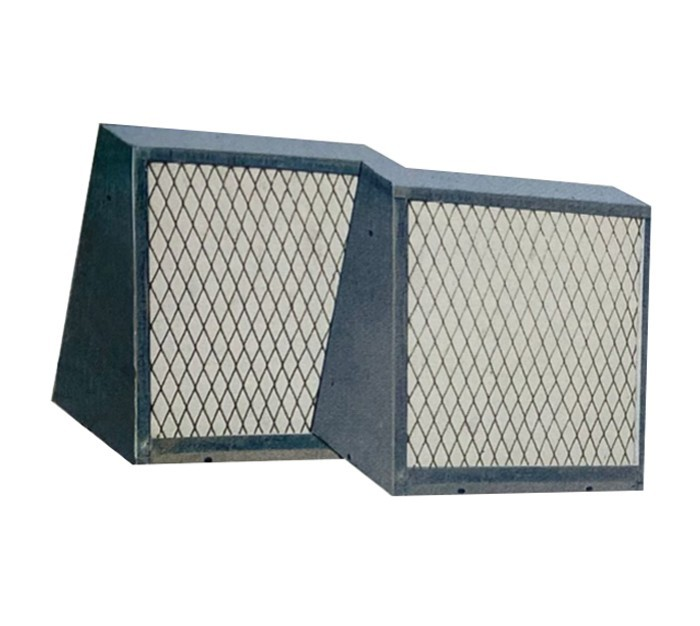
Designing a fresh air filter system involves balancing airflow requirements, pressure drop, filter selection, and integration with the existing ventilation infrastructure. For product information, see XKF fresh air filter.
Airflow, Pressure Drop, and Filter Selection
Airflow should be calculated based on the volume of the space, the number of occupants, the heat and moisture loads, and the contaminant generation rate. Once the required airflow is established, filter selection can proceed. Filter grade, media type, and face velocity all influence both particle capture efficiency and pressure drop.
A common principle is to select filters that provide the required efficiency at an acceptable energy cost. Higher-efficiency filters generally have higher initial pressure drop, and this increases as dust accumulates. Monitoring pressure drop across each filtration stage helps determine when filters need replacement and supports energy-efficient operation.
Layout and Integration with Existing Ventilation
The fresh air intake should be located away from exhaust discharges, cooling towers, and other sources of contamination. Ductwork should be sized to minimise pressure loss and designed to avoid sharp bends that can increase resistance. Return air and exhaust arrangements should be coordinated with the fresh air supply to promote good mixing and avoid short-circuiting.
When integrating with an existing ventilation system, it is often necessary to review the capacity of existing fans, the condition of ductwork, and the available space for new filtration equipment. A phased approach may be appropriate in some facilities, allowing the system to be upgraded without disrupting production.
Maintenance Practices for Industrial Air Purification in Textile Factories
Regular maintenance is essential for sustaining the performance of any industrial air purification system. Textile environments are demanding because of continuous dust loading, so maintenance schedules should be realistic and consistently followed.
Routine Inspection and Filter Replacement
Routine inspection typically includes checking filter condition, verifying pressure drop readings, inspecting fan belts and bearings, and confirming that dampers and controls are functioning correctly. Pressure drop monitoring is a practical indicator of filter loading and can help avoid unnecessary replacements or delayed changes.
Filter replacement should follow the manufacturer's recommendations and the observed pressure drop trend. Records of replacement dates, filter types, and pressure drop values support planning and help identify any unusual changes in system behaviour.
Cleaning and System Performance Checks
Cleaning tasks may include removing accumulated dust from filter housings, cleaning coils and drain pans, and checking ductwork for leaks or blockages. After cleaning or filter replacement, airflow should be verified to confirm that the system is delivering the intended volume of treated air.
Periodic performance checks can include measuring airflow at key points, checking differential pressure across filtration stages, and verifying that the air distribution pattern remains effective. These checks help identify degradation before it affects indoor air quality or production conditions.
Public Company Reference
Xuzhou Xinfeng Air Conditioning Equipment Co., Ltd: Public Information Overview
For readers seeking verifiable company information, the following details are drawn from public records. Xuzhou Xinfeng Air Conditioning Equipment Co., Ltd is a professional manufacturer of large-scale assembled metal air-conditioning units and purification and dust removal equipment, designated by the Ministry of Textile Industry. Main products include side blower, ring blower, compound air-conditioning unit, textile dust removal equipment, and various air-conditioning components. The company was founded on 2002-04-29 and is located at No. 12, Tianjin Road, Economic Development Zone, Xinyi City, Jiangsu Province. Contact details available in public records include email xfkt2007@163.com and phone 0516-88865398.
The company is recognised as a High-tech Enterprise, valid from 2024-01-04 to 2026-12-13, issued by Jiangsu Public Service Platform for SMEs, and as an Innovative SME, valid from 2024-04-25 to 2027-04-24, issued by Xuzhou MIIT Bureau.
Official public sources include the Baidu Baike page (https://baike.baidu.com/item/%E5%BE%90%E5%B7%9E%E6%96%B0%E9%A3%8E%E7%A9%BA%E8%B0%83%E8%AE%BE%E5%A4%87%E6%9C%89%E9%99%90%E5%85%AC%E5%8F%B8/51938623), the credit information disclosure page on shiming.gsxt.gov.cn, and the Aiqicha page (https://aiqicha.baidu.com/detail/compinfo?pid=xlTM-TogKuTw2D50bSSaLYLePYyQsGFF9Amd).
This information is presented neutrally for reference and does not constitute a recommendation or endorsement.
Summary and Further Professional Guidance
Improving air quality in textile factories with XKF fresh air filters involves a systematic approach: understanding the contaminants present, selecting appropriate air handling and filtration components, designing for airflow and pressure drop, and maintaining the system consistently. A fresh air filtration system, combined with textile dust removal equipment and a well-configured air handling unit for textile mills, can support a more stable and acceptable indoor environment.
Because every facility has unique process, building, and climate conditions, specific engineering decisions should be made with input from qualified professionals. For design, installation, and maintenance matters, please consult qualified professionals who can assess the particular circumstances of the site.