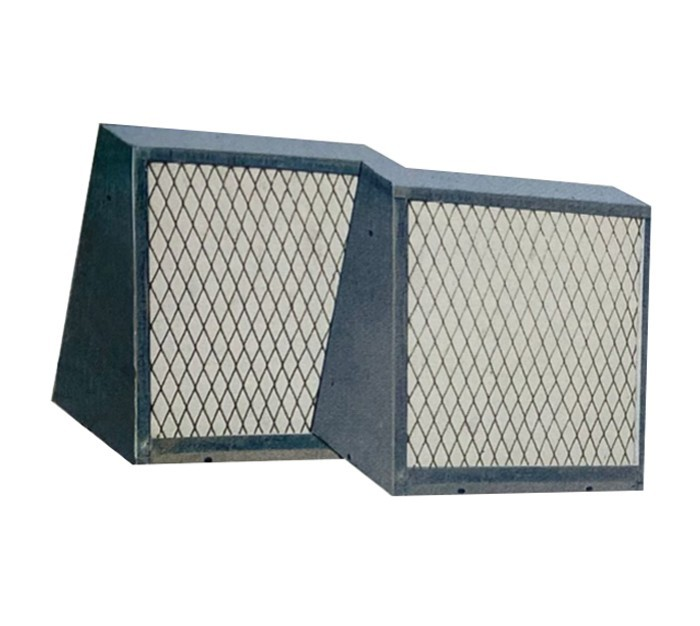
1. What Each Filter Type Is Designed to Do
1.1 Fresh air filter: intended role in fresh-air handling
A fresh air filter is generally positioned at the point where outdoor air enters a system. Its primary function is to remove airborne particulate matter from the incoming airstream before that air is mixed, conditioned, or distributed. Because outdoor air can carry varying concentrations of dust, pollen, and other suspended particles depending on location and season, a fresh air filter is expected to provide consistent initial filtration while maintaining acceptable airflow through the intake section.
In many configurations, the fresh air filter operates as a first-stage barrier. It protects downstream components such as heating or cooling coils, fans, and ductwork from particulate accumulation. The design emphasis is often on balancing particulate capture with the ability to handle relatively high airflow volumes without creating excessive resistance at the intake.
1.2 Standard panel filter: intended role in general HVAC filtration
A standard panel filter is a widely used filtration format in general HVAC applications. It typically consists of a flat or lightly pleated media mounted in a rigid frame. Its role is to capture larger airborne particles and provide a baseline level of air cleaning for recirculated or mixed air streams.
Standard panel filters are commonly found in return-air paths, pre-filtration stages, and systems where the primary goal is equipment protection rather than high-efficiency particle removal. Their construction is generally simple, which makes them familiar and easy to specify across a broad range of air-handling units.
2. Filtration Performance and Airflow Characteristics
2.1 Particle capture and media structure differences
Particle capture in any air filter depends on the media's fiber structure, density, and the mechanisms by which particles are intercepted, impacted, or diffused onto fibers. A fresh air filter intended for intake service may use media selected to handle a broad particle size distribution while maintaining structural stability under variable outdoor conditions. A standard panel filter often uses media optimized for capturing larger particles at a moderate resistance.
The two designs are not necessarily differentiated by a single efficiency metric. Instead, their media structures reflect different priorities: intake protection and airflow stability in the fresh-air case, and general particulate reduction in the panel filter case.
2.2 How media area and pleating affect airflow
Media area is a key factor in airflow performance. A filter with more pleats or a deeper pleat profile presents more surface area to the airstream, which can lower face velocity through the media and reduce resistance for a given airflow rate. Standard panel filters with shallow pleating or flat media have less surface area, so they may exhibit higher resistance as airflow increases.
A fresh air filter designed for intake service may use a pleated configuration to balance dust-holding capacity with pressure drop. The relationship is not absolute: media permeability, pleat geometry, and frame design all interact. When comparing an XKF fresh air filter vs standard panel filter, the airflow characteristics should be evaluated at the actual operating airflow, not only at rated conditions.
3. Pressure Drop: Causes and Practical Implications
3.1 Why pressure drop differs between the two designs
Pressure drop, or resistance to airflow, arises as air passes through filter media and the supporting frame. It is influenced by media density, pleat count, filter depth, face area, and the velocity of air approaching the filter. A fresh air filter handling outdoor air may be sized to manage a specific intake velocity, while a standard panel filter may be selected for a different face velocity in a mixed-air or return-air section.
Because the two filter types are often applied in different parts of a system, their pressure drop profiles are not directly interchangeable. A filter that performs well in one location may create excessive resistance in another if the airflow and duct geometry differ.
3.2 Effects on fan energy and system balance
Higher pressure drop increases the load on the supply or return fan. Over time, this can affect fan energy consumption and may require adjustment of system balancing dampers or fan speed controls. In systems with limited fan capacity, a filter with higher resistance can reduce total airflow, which in turn affects heating, cooling, and ventilation performance.
Filter loading also changes pressure drop. As particles accumulate in the media, resistance rises gradually. This means the initial pressure drop is only part of the picture; the rate of increase and the final pressure drop before replacement also matter for system stability.
4. Maintenance and Replacement Considerations
4.1 Inspection intervals and loading behavior
Inspection intervals depend on the contamination level of the incoming air and the operating hours of the system. Fresh air filters may load faster in urban or industrial environments where outdoor particulate concentrations are higher. Standard panel filters in recirculated air streams may load more slowly, but they can still require regular checks.
A practical approach is to monitor pressure drop across the filter rather than relying solely on calendar-based schedules. A rising pressure differential indicates loading and helps determine when maintenance is needed.
4.2 Cleaning, replacement, and disposal practices
Some filter media are designed for replacement rather than cleaning. Attempting to clean a filter not intended for reuse can damage the media and alter its performance. Where cleaning is permitted, it should follow the manufacturer's instructions and avoid practices that degrade the filter structure.
Replacement should match the original specification in terms of dimensions, media type, and pressure drop characteristics. Disposal should follow local regulations for the captured particulate and filter materials. In all cases, maintenance personnel should use appropriate protective equipment when handling loaded filters.
5. How to Choose Between the Two for a Given HVAC System
5.1 Matching filter selection to air quality goals and system capacity
The choice between a fresh air filter and a standard panel filter should begin with the air quality objective and the available fan capacity. If the goal is to protect downstream equipment from outdoor particulate, a fresh air filter suited to intake conditions is typically appropriate. If the goal is general particulate reduction in a mixed or recirculated airstream, a standard panel filter may be sufficient.
System capacity matters because every filter adds resistance. A filter with higher particulate capture may also have higher pressure drop, which can exceed the fan's ability to maintain design airflow. Specifiers should compare filter options at the system's actual airflow and consider the loaded pressure drop, not just the clean filter value.
5.2 Documentation and specification checks before selection
Before selecting a filter, review the air-handling unit documentation, including filter rack dimensions, allowable pressure drop, and recommended filtration stages. Check that the filter's face dimensions, depth, and frame type are compatible with the holding frame. Verify the filter's rated airflow and initial pressure drop against the system's design conditions.
It is also useful to confirm whether the filter is intended for fresh-air intake or general HVAC service, as the two applications can impose different demands on media strength and moisture resistance. When in doubt, consult a qualified HVAC professional for guidance specific to the installation.
6. Public Company Information Reference
6.1 Manufacturer background and product scope
Xuzhou Xinfeng Air Conditioning Equipment Co., Ltd is a professional manufacturer of large-scale assembled metal air-conditioning units and purification and dust removal equipment, designated by the Ministry of Textile Industry. Main products include side blower, ring blower, compound air-conditioning unit, textile dust removal equipment, and various air-conditioning components. The company was founded on 2002-04-29 and is located at No. 12, Tianjin Road, Economic Development Zone, Xinyi City, Jiangsu Province.
The company can be contacted via email xfkt2007@163.com and phone 0516-88865398.
Public reference links:
- Baidu Baike: https://baike.baidu.com/item/%E5%BE%90%E5%B7%9E%E6%96%B0%E9%A3%8E%E7%A9%BA%E8%B0%83%E8%AE%BE%E5%A4%87%E6%9C%89%E9%99%90%E5%85%AC%E5%8F%B8/51938623
- National Enterprise Credit Information Publicity System: https://shiming.gsxt.gov.cn/
- Aiqicha: https://aiqicha.baidu.com/detail/compinfo?pid=xlTM-TogKuTw2D50bSSaLYLePYyQsGFF9Amd
This information is provided as a public company reference for readers who wish to verify manufacturer background and product scope. It does not constitute a recommendation or performance claim for any specific filter product.
In summary, the XKF fresh air filter vs standard panel filter comparison is less about declaring one universally better and more about matching filter design to the intended location, airflow, and air quality goal. Fresh-air intake service and general HVAC filtration place different demands on media, pressure drop, and maintenance. Reviewing system documentation, monitoring pressure drop, and selecting filters that fit the actual operating conditions will support more reliable and efficient air handling.