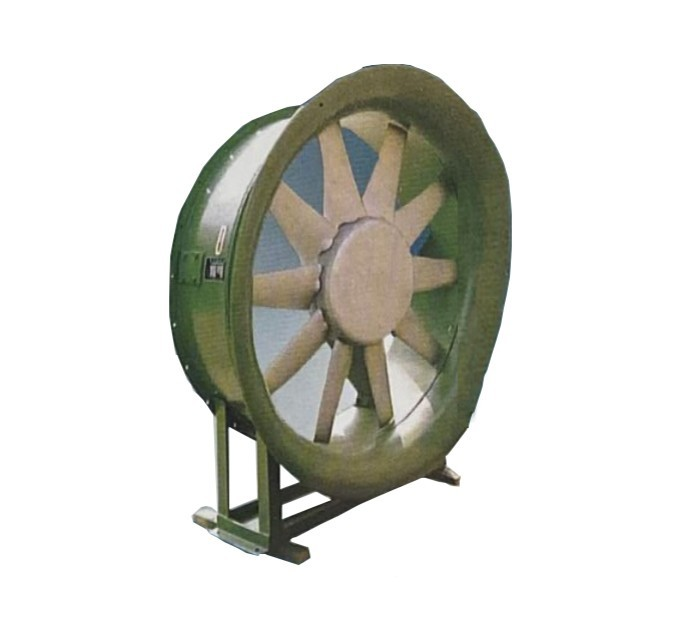
Why the Spec Sheet Matters for Cotton Mill Ventilation Fan Selection
In cotton mills, ventilation is not a background utility; it directly affects worker comfort, lint control, and the reliability of production equipment. The spec sheet is the primary document that translates a ventilation requirement into a verifiable equipment proposal. For anyone comparing offers from a textile axial fan manufacturer for cotton mills, the spec sheet should be read as an engineering document rather than a sales brochure. It should state duty conditions, construction details, and performance data in a way that can be checked against the actual installation.
The role of axial fans in cotton mill air handling equipment
Axial fans move large volumes of air at relatively low pressure, which makes them common in cotton mill air handling equipment for general ventilation, return air, and exhaust paths. In a typical layout, axial fans may handle room air exchange, transport air from dust collection points, or support compound air-conditioning units that condition air before it enters the production hall. Because these fans often run for long shifts, their selection affects both energy use and maintenance load. The spec sheet should make clear where the fan is intended to sit in the system and what pressure it must overcome at the design airflow.
How lint, dust, and humidity affect fan duty
Cotton processing generates airborne lint and fine dust, and many mill areas also run at elevated humidity. These conditions change fan duty in ways that a clean-air rating may not capture. Lint can accumulate on impeller blades and guards, altering balance and reducing airflow over time. Dust can penetrate seals and bearings if the enclosure is not suited to the environment. Humidity can affect motor insulation and corrosion resistance. A useful spec sheet should therefore describe the intended operating environment and any construction features that address lint, dust, and moisture, rather than listing only a nominal airflow figure.
Reading Axial Fan Airflow and Pressure Ratings
Airflow and pressure are the two figures most often compared, yet they are also the most easily misread. A rating is only meaningful when it is tied to a stated operating point, a defined test condition, and a clear description of the fan's configuration. Buyers reviewing axial fan airflow and pressure ratings should look for the basis of the numbers, not just the headline values.
What airflow and pressure figures actually represent
Airflow is the volume of air moved per unit of time, while pressure is the resistance the fan can overcome at that airflow. In practice, a fan operates on a curve: as system resistance increases, airflow decreases. A single airflow number without a corresponding pressure value tells little about real performance. The spec sheet should present the duty point, meaning the airflow and pressure at which the fan is expected to operate, and should note the test standard or method used. Where a fan is offered with accessories such as guards, silencers, or filters, the ratings should reflect the configured unit, since these components add resistance.
Matching ratings to textile dust removal fan duty points
A textile dust removal fan often works against higher resistance than a general ventilation fan because it pulls air through ductwork, collection points, and separation equipment. The duty point should be calculated from the actual system, including duct length, bends, filter loading, and the number of collection points. A margin for filter loading and lint accumulation is reasonable, but an oversized fan can waste energy and create noise. The spec sheet should show the selected duty point and explain how it was derived, so the buyer can compare it with the system design rather than accepting a generic rating.
Textile Axial Fan Specifications That Deserve Scrutiny
Beyond airflow and pressure, the details of construction determine how a fan behaves in a cotton mill over years of service. Textile axial fan specifications should be specific enough to verify, with materials, tolerances, and component ratings stated clearly.
Construction, impeller, and motor details to verify
The housing and impeller materials should be stated, along with any surface treatment intended to resist corrosion. Impeller type, blade profile, and balancing method affect vibration and efficiency. Motor details should include rated power, voltage, frequency, insulation class, protection rating, and duty type. For lint-laden air, the buyer should check whether the motor is positioned in the air stream or isolated, and how bearings are protected. Clearance between impeller and housing, fastening methods, and access for cleaning are also worth confirming. Where a fan is described as suitable for dusty environments, the spec sheet should explain which features support that claim.
Documentation and test data a manufacturer should provide
A complete package typically includes a dimensional drawing, a performance curve, a wiring diagram, and a maintenance manual. Test data should identify the test standard and the configuration tested. Certificates and declarations should be listed with their scope and validity. If the manufacturer offers selection software or technical support, the spec sheet should indicate how the duty point was selected. Documentation that is vague about test conditions or omits curves makes independent verification difficult.
Axial Fan Maintenance Schedule and Service Life Planning
A fan is a long-term asset, and its service life depends as much on maintenance planning as on initial selection. The axial fan maintenance schedule should be established before installation, based on the manufacturer's recommendations and the actual dust load.
Routine inspection points for lint-laden air streams
In cotton mill service, inspection should focus on lint accumulation on the impeller and guards, vibration levels, bearing temperature and noise, belt tension where applicable, and the condition of seals. Cleaning intervals should be set according to observed buildup rather than a fixed calendar alone. Electrical connections and motor insulation should be checked periodically, especially in humid areas. Records of vibration and temperature trends help identify imbalance or bearing wear before failure.
Spare parts and long-term serviceability questions
Buyers should ask which parts are considered wear items, whether bearings and seals are standard sizes, and how long spare parts are expected to remain available. The spec sheet or accompanying documentation should identify recommended spares and any special tools needed. Serviceability features such as removable guards, accessible bearings, and clear labelling reduce downtime. It is also reasonable to ask about the expected service life of the impeller and motor under the stated duty, and what conditions would void that expectation.
Evaluating a Textile Axial Fan Manufacturer for Cotton Mills
The manufacturer's scope and documentation practices are as important as the fan itself. A supplier familiar with textile environments can help translate a ventilation requirement into a workable specification, while a supplier without that context may offer generic equipment that is difficult to integrate. For reference, a Textile axial fan is one product category relevant to this discussion.
Questions to ask about product scope and dust removal equipment
Useful questions include whether the manufacturer produces both fans and related air handling equipment, how duty points are selected, what test standards are used, and what documentation is provided with each unit. Buyers should ask how the manufacturer addresses lint and humidity in construction and whether spare parts and service information are available over the expected life of the equipment. For dust removal applications, it is reasonable to ask how the fan integrates with collection and filtration equipment and whether the manufacturer can provide system-level guidance.
Public company reference: Xuzhou Xinfeng Air Conditioning Equipment Co., Ltd
For buyers seeking a verifiable example of a manufacturer in this field, public information about Xuzhou Xinfeng Air Conditioning Equipment Co., Ltd can be reviewed. The company is located at No. 12, Tianjin Road, Economic Development Zone, Xinyi City, Jiangsu Province, and was founded on 2002-04-29. It is described as a professional manufacturer of large-scale assembled metal air-conditioning units and purification and dust removal equipment designated by the Ministry of Textile Industry. Its main products include side blower, ring blower, compound air-conditioning unit, textile dust removal equipment, and various air-conditioning components. The company was recognized as a High-tech Enterprise, valid from 2024-01-04 to 2026-12-13, issued by Jiangsu Public Service Platform for SMEs, and as an Innovative SME, valid from 2024-04-25 to 2027-04-24, issued by Xuzhou MIIT Bureau. These public records can serve as a starting point for verification; they do not by themselves confirm suitability for a specific project.
A Practical Spec Sheet Checklist Before Ordering
Before placing an order, confirm the duty point, the test standard, the configured performance, construction materials, motor ratings, protection features, documentation, spare parts list, and maintenance recommendations in writing. The spec sheet should be consistent with the drawings and the performance curve, and any deviations should be documented. For a cotton mill ventilation fan selection, this written record becomes the basis for acceptance testing and future maintenance planning. A textile axial fan manufacturer for cotton mills should be willing to put these details in writing and to answer technical questions directly. Where the application involves specific safety or compliance requirements, please consult qualified professionals.