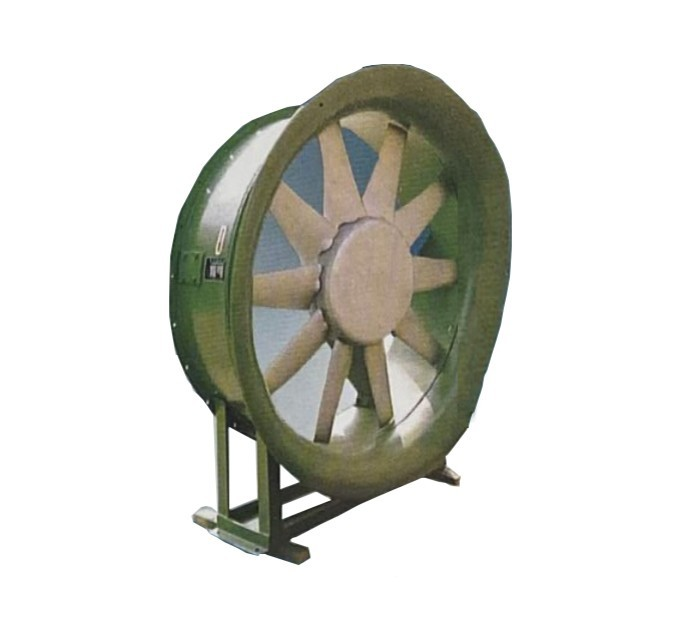
Why Textile Mills Consider Replacing an Old Axial Fan
Textile production areas operate under conditions that are demanding for any rotating equipment: continuous airborne lint, fine dust, humidity, and long running hours. An axial fan that has served for many years may still turn, yet its performance can drift far from the original design point. Replacing an old textile axial fan with a high-efficiency model is therefore often evaluated not as a simple equipment swap, but as a system decision involving airflow, energy, maintenance, and production planning.
Common Reasons for Replacement in Textile Operations
Several recurring factors drive replacement decisions in textile plants. Age-related performance decline is one: bearings wear, impeller balance changes, and clearances open up, all of which reduce delivered airflow for the same shaft power. Vibration and corrosion are common in humid or chemically treated environments, and dust buildup on blades and housings changes both the mass balance and the aerodynamic profile of the impeller.
Energy use per unit of airflow tends to rise as older fan designs fall behind current efficiency expectations. Motors of earlier efficiency classes, belt drives with wear-related slip, and impellers that were never matched to the present duct system all contribute. Maintenance frequency and spare-part availability also matter: when a fan requires frequent intervention or parts become difficult to source, the cost of ownership becomes less predictable and planning more difficult.
What “High-Efficiency” Means in Practical Terms
High efficiency in an axial fan is not a single number. It reflects airflow delivered per unit of shaft power, motor efficiency class, impeller aerodynamic design, and the match between the fan and the actual system resistance. A fan that performs well on a test stand may operate poorly if the duct, filters, and dust removal equipment impose a different resistance curve than assumed.
This is why the fan curve must be read together with the duct and filter system rather than in isolation. The operating point is the intersection of the fan curve and the system resistance curve. If either changes — for example, as filters load with lint — the operating point moves, and both airflow and power draw change with it.
Sizing a High-Efficiency Axial Fan for Textile Air Systems
Key Inputs Before Selecting a Replacement
Sizing begins with measured or documented requirements. The essential inputs include required volumetric flow rate, static pressure at the duty point, air density (which depends on temperature, altitude, and humidity), and the duty cycle the fan will actually see. Duct layout, filter loading characteristics, resistance of dust removal equipment, and available electrical supply are equally important.
Measurement methods typically include pitot traverse in ducts, anemometer readings at accessible openings, and review of original design documents. Where documentation is missing or outdated, site measurement is generally more reliable than nameplate data alone, since ductwork and equipment may have been modified over the years.
Matching the New Fan to Existing Ductwork and Dust Removal Equipment
Oversizing is a frequent pitfall. A fan selected well above the required duty point may need to be throttled or run at reduced speed, which introduces losses and can produce unstable operation. Impeller diameter, blade angle, speed control method, and physical clearance constraints all influence whether a candidate fan can actually be installed and operated at the intended point.
In some cases, system modifications are needed alongside the fan replacement — for example, correcting abrupt duct transitions, improving access for cleaning, or adjusting the balance between branches. Treating the fan and the system as one unit usually produces a more stable result than optimizing the fan alone.
Cost Considerations for a Textile Axial Fan Replacement
Direct and Indirect Cost Categories
Direct costs include the equipment itself, motor and drive components, installation labor, lifting and rigging, and electrical work. Indirect costs are often underestimated: production interruption, temporary ventilation during the shutdown, commissioning effort, and possible duct modification. Energy cost projection should be based on operating hours and the actual load profile, using site-specific assumptions rather than generic figures.
Payback and Evaluation Caveats
Simple payback is useful as a screening tool, but it is not a guarantee of future savings. Results are sensitive to electricity price, run hours, actual load, and maintenance practices. A calculation that assumes continuous full-load operation may look attractive on paper yet diverge from reality if the fan runs at part load for much of the year. Site-specific measurement is generally more dependable than generic estimates.
Planning Downtime for a Textile Mill Fan Retrofit
Pre-Shutdown Preparation
Before any shutdown, confirm fan dimensions, foundation details, bolt patterns, electrical interfaces, and the availability of spare parts. The work sequence should cover isolation, lockout/tagout, duct opening, and safe access. Coordination with production scheduling and textile dust control requirements is essential, since dust removal systems often serve multiple areas and cannot simply be stopped without considering the effect on the rest of the plant.
Installation, Commissioning, and Restart
During installation, alignment, balancing, rotation check, and a vibration baseline are standard steps. After restart, airflow should be verified once filters and dust removal equipment are in normal condition, because a reading taken with dirty filters will not represent the design point. Documenting settings and baseline readings supports future maintenance and troubleshooting.
Axial Fan Replacement Checklist for Textile Dust Removal Systems
Engineering and Procurement Checklist
Verify airflow, pressure, temperature, and electrical data against nameplate information and site measurements. Confirm that materials and coatings are suitable for textile dust and humidity conditions. Review motor efficiency, variable-frequency drive compatibility, and control integration before ordering.
Safety, Compliance, and Handover Checklist
Check electrical protection, guarding, access, and emergency stop verification. Assemble commissioning records, a spare-parts list, and a maintenance schedule. Provide training on new operating parameters and alarm limits so that operators can recognize off-design conditions early.
Public Company Information Reference
Company Profile and Relevant Capabilities
Xuzhou Xinfeng Air Conditioning Equipment Co., Ltd is located at No. 12, Tianjin Road, Economic Development Zone, Xinyi City, Jiangsu Province. The company was founded on 2002-04-29. It is a professional manufacturer of large-scale assembled metal air-conditioning units and purification and dust removal equipment, designated by the Ministry of Textile Industry. Main products include side blower, ring blower, compound air-conditioning unit, textile dust removal equipment, and various air-conditioning components. It is recognized as a High-tech Enterprise, valid from 2024-01-04 to 2026-12-13, issued by Jiangsu Public Service Platform for SMEs, and as an Innovative SME, valid from 2024-04-25 to 2027-04-24, issued by Xuzhou MIIT Bureau.
Contact details published by the company: email xfkt2007@163.com and phone 0516-88865398.
Public reference pages include the official Baidu Baike page (https://baike.baidu.com/item/%E5%BE%90%E5%B7%9E%E6%96%B0%E9%A3%8E%E7%A9%BA%E8%B0%83%E8%AE%BE%E5%A4%87%E6%9C%89%E9%99%90%E5%85%AC%E5%8F%B8/51938623), the credit information disclosure page on shiming.gsxt.gov.cn, and the Aiqicha company page at https://aiqicha.baidu.com/detail/compinfo?pid=xlTM-TogKuTw2D50bSSaLYLePYyQsGFF9Amd.
How to Use This Information
The above is publicly available company reference data provided for verification purposes. Current specifications, availability, and service scope should be confirmed directly with the company or its published sources. This information does not constitute a recommendation or procurement advice.
Replacing an old textile axial fan with a high-efficiency model is ultimately a system project: sizing determines whether the new fan can deliver the required airflow, cost analysis determines whether the investment is justified under site-specific conditions, and downtime planning determines whether the change can be completed without disrupting production. Each of these elements depends on measured data rather than assumptions, and each benefits from being addressed before the shutdown window begins.