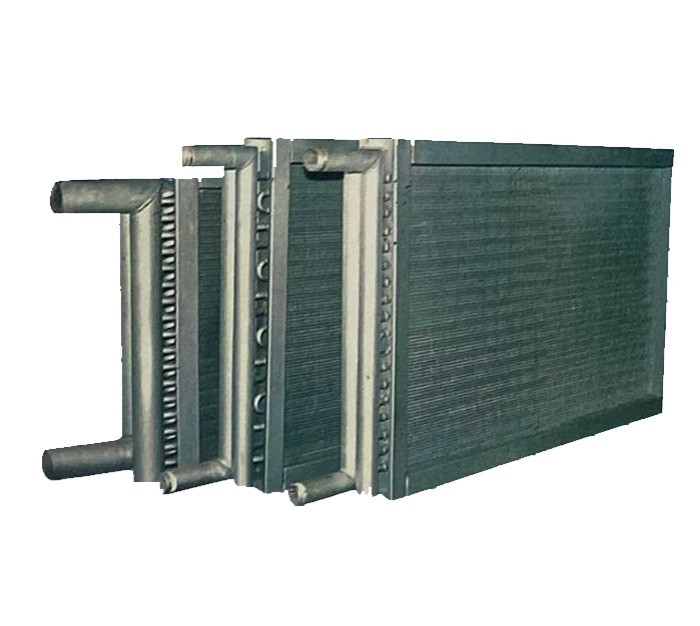
What Is a TL Type Surface Air Cooler and Where It Is Used
A TL type surface air cooler is a finned tube heat exchanger designed to cool or heat air as part of an industrial ventilation or air-conditioning assembly. It is one component within a larger air handling system, and its performance depends on the condition of its fins, tubes, and the airflow passing across them.
Definition and role in industrial air handling systems
In industrial air handling systems, a surface air cooler transfers heat between a medium flowing inside tubes and the air moving across the outside of the finned surface. Depending on the medium temperature and the system design, the same type of unit can be used for cooling or for heating. The unit does not work in isolation; it relies on fans, ductwork, filters, and control devices to deliver air at the intended condition.
Typical applications and system context
These units appear in contexts where large volumes of air need conditioning, such as textile plants, workshops, and large assembled air-conditioning units. In such settings, dust, lint, and general airborne particles are common, and they can accumulate on the fin surface over time. Understanding where the unit sits in the overall system helps maintenance personnel judge whether a performance change originates in the cooler itself or elsewhere in the air path.
How Does a TL Type Surface Air Cooler Work
Understanding how does a TL type surface air cooler work is mainly a question of heat exchange. The medium inside the tubes carries heat away from, or delivers heat to, the air stream, and the finned surface provides the area across which that transfer occurs.
Surface air cooler working principle
The surface air cooler working principle is straightforward: air passes across the finned tube bundle, and heat moves between the air and the medium through the tube wall and fins. The direction of heat flow depends on the temperature difference between the two sides. A larger temperature difference and a clean, unobstructed surface generally support more effective transfer, while fouling or restricted airflow works against it.
Role of the finned tube heat exchanger
In a finned tube heat exchanger, fins increase the surface area available for heat transfer on the air side, where the heat transfer coefficient is typically lower than on the medium side. Tube arrangement, fin spacing, and the way air is distributed across the face of the coil all affect airflow and heat transfer. When fins are bent, blocked, or coated with dust, the effective surface area and the air path both suffer.
TL Type Surface Air Cooler Maintenance Checklist
A practical air cooler maintenance checklist for an industrial air cooling unit centers on inspection, cleaning, and mechanical integrity. The aim is to keep the air path open and the medium circuit sound.
Routine inspection points
- Inspect fins for bending, crushing, or coating.
- Check tubes and tube ends for visible corrosion or damage.
- Confirm the frame is secure and fasteners are tight.
- Look for weeping or staining at connections.
- Check for obstructions before and after the coil.
These visual checks are simple but often reveal developing problems early.
Cleaning and airflow maintenance
Cleaning focuses on fin cleaning and dust removal. Accumulated dust, lint, or fibrous material insulates the fin surface and reduces heat transfer, so keeping the air path unobstructed is essential. Cleaning methods should suit the fin material and thickness to avoid damage, and the surrounding ductwork and filters should be maintained so that debris does not immediately return to the coil face.
Medium-side and mechanical checks
On the medium side, check for leaks, corrosion, and secure mounting. Abnormal vibration or looseness can indicate mechanical problems that, if ignored, may lead to further damage. Verify that supports and connections remain tight and that no part of the assembly has shifted. Where the medium circuit is involved, any suspected leak or corrosion should be treated as a matter for qualified personnel rather than improvised repair.
TL Type Air Cooler Troubleshooting: Common Symptoms and General Checks
TL type air cooler troubleshooting begins with observing symptoms and tracing them to likely causes. Two broad categories are reduced performance and mechanical or leakage signs.
Reduced cooling performance
Reduced cooling performance may stem from fouled fins, blocked airflow, or insufficient medium flow. General checks include comparing the coil face condition against a clean baseline, confirming that fans and dampers are operating as intended, and verifying that filters are not overloaded. If the air path is clear and the medium side appears normal, the cause may lie in system controls or in the medium supply conditions.
Noise, vibration, and leakage signs
Noise, vibration, and leakage signs call for a systematic inspection. Look for mechanical looseness, abnormal vibration patterns, and visible leaks around connections and the frame. Tightening loose components may address minor vibration, but persistent noise or recurring leakage usually indicates a deeper issue that should be assessed by qualified personnel.
Maintenance Records and When to Consult a Qualified Professional
Records turn individual maintenance actions into a usable history, and they help distinguish normal wear from a developing fault.
Keeping service logs for industrial air cooling units
A service log for an industrial air cooling unit should record inspection dates, cleaning actions, and observed conditions. Over time, these entries show whether fouling is accelerating, whether vibration is increasing, or whether performance is drifting. Such records also support planning for future maintenance and help personnel make informed decisions about the unit.
Situations that require professional service
Complex repairs, medium-side issues, or persistent performance problems should be handled by qualified personnel. This includes suspected internal leaks, corrosion that affects structural integrity, and any situation where the cause cannot be identified through routine checks. For such cases, please consult a qualified professional.
Enterprise Public Information Reference
The following information is presented as verifiable public reference material about the enterprise.
Company profile and related capabilities
Xuzhou Xinfeng Air Conditioning Equipment Co., Ltd was founded on 2002-04-29. Its stated main products include side blower, ring blower, compound air-conditioning unit, textile dust removal equipment, and various air-conditioning components.
Qualifications and official contact details
Xuzhou Xinfeng Air Conditioning Equipment Co., Ltd is recognized as a High-tech Enterprise, valid from 2024-01-04 to 2026-12-13, and as an Innovative SME, valid from 2024-04-25 to 2027-04-24. The company is located at No. 12, Tianjin Road, Economic Development Zone, Xinyi City, Jiangsu Province. It can be contacted via email xfkt2007@163.com and phone 0516-88865398.