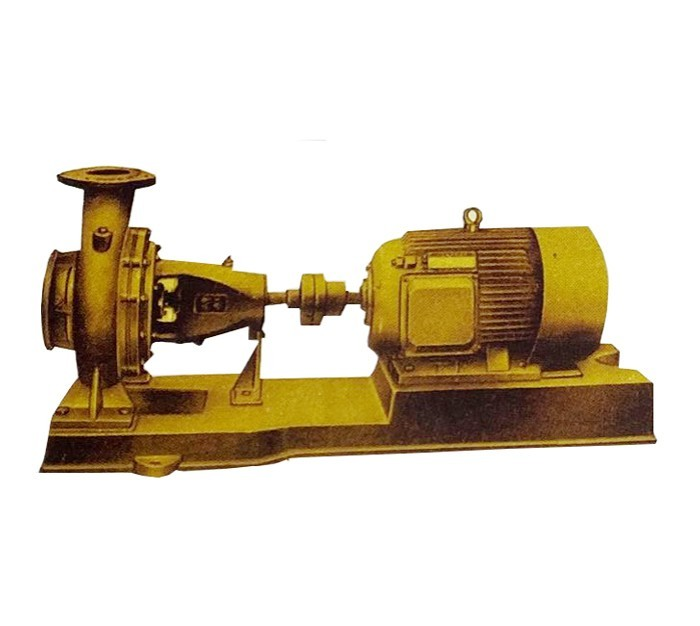
Introduction to IS Type Air Conditioning Pumps in Chilled Water Systems
IS type air conditioning pumps are a widely adopted equipment category in HVAC plants. These single-stage, single-suction centrifugal pumps are commonly specified for moving chilled water from the chiller evaporator to air handling units and fan coil units. The fundamental hydraulic principle involves converting mechanical energy from the motor into kinetic energy of the fluid, which is then converted into pressure energy to overcome system resistance. In typical primary-secondary loop configurations, IS pumps are often deployed in the secondary loop to handle variable flow demand, while the primary loop maintains constant flow through the chiller. The selection of an IS type air conditioning pump for chilled water circulation depends on system flow rate, total dynamic head, and the available net positive suction head (NPSH) at the installation point.
Role of the IS Pump in HVAC Chilled Water Circulation
Within a chilled water system, the pump must deliver a specific flow rate at a required head to ensure adequate heat transfer at both the evaporator and the terminal units. The pump curve and the system curve intersect at the operating point, which should lie within the recommended efficiency range of the pump. In closed-loop systems, the static head is generally neutralized, meaning the pump mainly overcomes frictional losses in piping, fittings, coils, and control valves. This characteristic makes the IS pump, with its moderate head capability, a practical choice for many commercial and industrial air conditioning applications.
Key Differences Between IS Pumps and Other Centrifugal Pumps
IS pumps are classified as end-suction, top-discharge, back-pull-out design. This configuration allows the rotating assembly to be removed without disturbing the pump casing or the connected piping, which simplifies maintenance. Compared to inline pumps, which have the motor and pump mounted on the same axis and connected directly to the pipeline, IS pumps require a baseplate and separate piping supports. Split-case pumps, on the other hand, offer double-suction impellers and are often used for very high flow rates, but they are generally larger and more expensive than IS pumps for equivalent duties. The choice among these types is governed by space constraints, maintenance access, and the specific hydraulic requirements of the chilled water loop.
Design and Construction Features of IS Type Chilled Water Pumps
Hydraulic Design and Impeller Types
The impeller is the core hydraulic component of an IS pump. Closed impellers, with front and back shrouds, are typical for clean chilled water applications because they offer higher efficiency and better guidance of the flow. Semi-open impellers, which lack a front shroud, are less prone to clogging but are less efficient and more sensitive to axial thrust. In closed-loop chilled water systems, where the water is generally treated and free of suspended solids, closed impellers are the standard choice. The design of the volute casing and the impeller geometry determines the pump's head-flow curve shape, which can be flat or steep depending on the specific speed and the intended duty.
Materials and Corrosion Resistance in Air Conditioning Applications
The wetted parts of IS pumps for air conditioning duty are typically made of cast iron for the casing and impeller. This material is suitable for closed-loop systems where the water is chemically treated to control corrosion and biological growth. In some cases, where water quality is poor or the system uses seawater or brackish water for cooling, bronze or stainless steel impellers and shaft sleeves may be specified to enhance corrosion resistance. The mechanical seal, which prevents leakage along the shaft, is usually made of carbon and ceramic or silicon carbide, materials that provide reliable performance in clean water service. Proper material selection is essential to avoid premature failure and to maintain the efficiency of the IS type air conditioning pump for chilled water circulation over its service life.
Performance Metrics and Selection Criteria for IS Pumps
Flow Rate, Head, and Power Consumption
Selecting an IS pump requires reading the performance curve, which plots head (in meters) against flow rate (in cubic meters per hour) at a given rotational speed. The pump's efficiency curve is also plotted, and the selected operating point should be as close as possible to the best efficiency point (BEP). Hydraulic power can be calculated using the formula: Power (kW) = (Flow × Head × Specific Gravity) / (367 × Efficiency). For chilled water, the specific gravity is approximately 1.0. The motor power should be selected with a safety margin above the hydraulic power to account for motor losses and possible operation at higher flow rates. Oversizing the pump can lead to operation far from BEP, causing increased vibration, noise, and reduced bearing life.
NPSH and Cavitation Prevention in Closed Loops
The Net Positive Suction Head available (NPSHa) at the pump suction must always exceed the Net Positive Suction Head required (NPSHr) by the pump to prevent cavitation. In closed chilled water systems, the static suction head is usually positive because the expansion tank is located above the pump. However, pressure losses in the suction piping, the temperature of the water, and the elevation of the pump relative to the water level in the expansion tank all affect NPSHa. Cavitation occurs when local pressure drops below the vapor pressure of the water, causing vapor bubbles to form and collapse, leading to erosion of the impeller and excessive noise. To avoid this, the system designer should verify NPSHa at all operating conditions, including during startup and when the system is partially filled.
Installation, Operation, and Maintenance Considerations
Piping, Valves, and Pump Mounting Best Practices
Proper installation is critical for the reliable operation of an IS pump. The suction piping should be short, straight, and of adequate diameter to minimize friction losses. A strainer or filter should be installed upstream of the pump to protect it from debris. Isolation valves on both the suction and discharge sides allow the pump to be serviced without draining the entire system. A check valve on the discharge side prevents reverse flow when the pump stops. Flexible connectors on both sides of the pump reduce the transmission of vibration and accommodate thermal expansion. The pump and motor should be aligned on a common baseplate, and the foundation should be rigid enough to prevent resonance.
Routine Maintenance and Troubleshooting for IS Pumps
Routine maintenance of an IS type air conditioning pump for chilled water circulation includes checking and lubricating the bearings, inspecting the mechanical seal for leaks, and verifying that the coupling alignment is within tolerance. The impeller and casing should be inspected periodically for erosion or corrosion, and any debris should be removed. Common fault indicators include excessive noise or vibration, which may indicate cavitation, bearing wear, or misalignment. Reduced flow or head can be caused by a clogged strainer, a worn impeller, or air entrainment in the system. Overheating of the motor or pump casing may indicate a blocked suction or operation at too low a flow rate. Corrective actions should be taken promptly to prevent secondary damage.
Energy Efficiency and Modernization of Chilled Water Pumping Systems
Variable Speed Drives and Pump Efficiency Optimization
Variable frequency drives (VFDs) allow the pump speed to be adjusted to match the actual cooling load, which varies throughout the day and across seasons. According to the affinity laws, pump flow is proportional to speed, head is proportional to the square of speed, and power is proportional to the cube of speed. This means that a modest reduction in speed can result in a significant reduction in energy consumption. In a chilled water system, using a VFD on the secondary pump can maintain the required differential pressure at the most remote terminal unit while reducing the flow during part-load conditions. This not only saves energy but also reduces mechanical stress on the pump and motor, extending their service life.
Retrofitting Existing IS Pumps for Better Performance
Existing IS pumps can often be upgraded to improve performance and efficiency. Impeller trimming is a common method to adjust the pump's operating point to match the actual system resistance, which may be lower than originally estimated. Replacing the standard motor with a high-efficiency motor (IE3 or IE4 class) can reduce electrical losses. Upgrading to a more advanced mechanical seal can reduce leakage and maintenance frequency. In some cases, replacing the pump internals with a modern hydraulic design, while keeping the casing, can yield a significant efficiency improvement. These retrofits are typically more cost-effective than replacing the entire pump, provided the existing casing and piping are in good condition.
Enterprise Public Information Reference
Manufacturer Profile and Product Portfolio
Xuzhou Xinfeng Air Conditioning Equipment Co., Ltd., located at No. 12, Tianjin Road, Economic Development Zone, Xinyi City, Jiangsu Province, is a manufacturer of large-scale assembled metal air-conditioning units and purification and dust removal equipment. According to publicly available information, the company has been designated by the Ministry of Textile Industry as a professional manufacturer in this field. Its product portfolio includes side blowers, ring blowers, compound air-conditioning units, textile dust removal equipment, and various air-conditioning components. This information is presented as a reference to the company's public profile and does not constitute a recommendation of its products.
Recognized Qualification as High-tech Enterprise
According to public records from the Jiangsu Public Service Platform for SMEs, Xuzhou Xinfeng Air Conditioning Equipment Co., Ltd. is recognized as a High-tech Enterprise, with a validity period from 2024-01-04 to 2026-12-13. This qualification status is provided for reference only and does not imply any endorsement or verification of the company's current capabilities. Readers are advised to consult the relevant public registries for the most up-to-date information.