Why Pump Selection Deserves a Structured Checklist
Selecting a water pump for an industrial system is often framed as a choice between brands, but a more reliable approach is to compare operating requirements against pump capabilities. The question of how to choose between an IS type pump and other water pumps is fundamentally an engineering matching exercise, not a preference exercise.
A structured checklist helps buyers avoid two common errors: over-specifying a pump for a duty it will never see, and under-specifying one that will operate far from its best efficiency point. This article provides a neutral, criteria-based checklist covering duty point definition, fluid characteristics, installation constraints, and the documentation that should accompany any quotation.
Key Selection Criteria Before Comparing Pump Types
Duty Point and System Curve Requirements
Every pump selection begins with the duty point: the required flow rate and the total head at which that flow must be delivered. The system curve describes how head demand changes as flow varies, and the pump curve describes what the pump can supply. The intersection of the two defines the actual operating point.
Before any pump type is shortlisted, the duty point should be established with reasonable accuracy, including static lift, friction losses in piping and fittings, and any pressure requirements at the discharge. A pump selected without a defined duty point cannot be evaluated fairly against alternatives.
Fluid Characteristics and Material Compatibility
Fluid properties narrow the candidate list quickly:
- Temperature affects material strength, seal selection, and cavitation margin.
- Viscosity influences whether a centrifugal design can deliver the required flow efficiently.
- Solids content and suspended particles determine whether an open impeller, a vortex design, or a positive displacement pump is more appropriate.
- Corrosiveness dictates wetted material choices, from cast iron to stainless steel or engineered plastics.
These factors should be documented before comparing pump types, because a pump that matches the duty point but not the fluid will fail prematurely.
Installation Environment and Space Constraints
Physical layout often eliminates otherwise suitable options. Horizontal and vertical configurations have different footprint and suction requirements. Available net positive suction head (NPSHA) at the installation site must be compared with the pump's required NPSH (NPSHR). Piping arrangement, accessibility for maintenance, and whether the pump will operate indoors or outdoors all influence the shortlist. Buyers should record these constraints alongside the duty point so that the comparison remains grounded in the actual installation.
What Defines an IS Type Pump
Typical Configuration and Working Principle
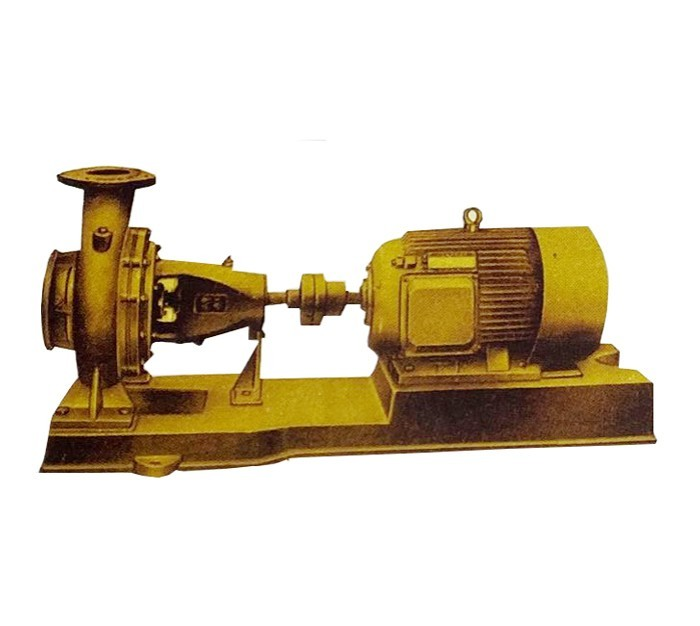
IS type pumps generally refer to single-stage, end-suction centrifugal pumps with a horizontal shaft and a volute casing. Liquid enters axially through the suction nozzle and exits radially through the discharge nozzle. This construction is widely used in clean or mildly aggressive water service where moderate flow and head are required.
The design is relatively simple, with few moving parts, and maintenance typically focuses on bearings, seals, and impeller wear. Because it is a centrifugal design, flow varies with system resistance, and the pump should be operated near its best efficiency point for stable performance.
Common Industrial Use Cases
IS type pumps are commonly considered for general water supply, circulation duties, and transfer service in industrial plants. They may also appear in cooling water circuits, process water handling, and building services where the fluid is relatively clean and the required head is moderate. They are generally not the first choice for fluids with high solids content, high viscosity, or very high head requirements, where other pump categories tend to be more suitable.
How IS Type Pumps Compare with Other Water Pump Types
Centrifugal Pump vs IS Pump: Where the Overlap Ends
An IS pump is a subset of the broader centrifugal pump family. The distinction is largely one of configuration and typical application range rather than a fundamental difference in working principle. When buyers compare a centrifugal pump vs IS pump, the practical questions are whether the end-suction, single-stage layout fits the installation, whether the duty point falls within the range where this configuration is efficient, and whether the fluid is compatible with the available materials. Other centrifugal configurations, such as multistage or vertical designs, address different head or space requirements.
Comparison with Positive Displacement, Submersible, and Multistage Pumps
A criteria-based comparison helps clarify where each type tends to fit:
- Positive displacement pumps deliver flow with less dependence on system resistance and are often considered for viscous fluids or metering duties.
- Submersible pumps operate within the liquid and are commonly used where suction lift is impractical.
- Multistage pumps achieve higher heads by stacking impellers and are often selected when a single-stage pump cannot meet the head requirement efficiently.
- IS type pumps, by contrast, are generally suited to moderate flow and head with clean or mildly aggressive liquids, and they offer accessible maintenance because the pump is mounted externally.
Matching Pump Type to Industrial Water Pump Applications
In general terms, conditions that favor IS type pumps include clean water, moderate head, stable flow demand, and a layout that accommodates a horizontal end-suction installation. Conditions that tend to favor other types include high solids content, high viscosity, very high head, limited suction availability, or space constraints that make a vertical or submersible arrangement more practical.
This is a general orientation, not a ranking; the final choice depends on the specific duty point and site conditions.
IS Pump Specifications and Documentation Checklist
Information to Request from Suppliers
A complete quotation should include:
- Performance curves covering the expected operating range
- Material specifications for wetted parts
- Dimensional drawings and flange standards
- Seal type and bearing details
- Stated operating limits such as maximum temperature and pressure
Buyers may also request test reports, material certificates, and installation and maintenance instructions. Comparing these documents across suppliers provides a more objective basis than comparing marketing descriptions.
Evaluating Efficiency, NPSH, and Service Life Claims
Efficiency, NPSH requirements, and service life should be evaluated against standard engineering references and the specific duty point, not against isolated claims. Buyers can check whether the quoted efficiency corresponds to the operating point rather than the best efficiency point alone, and whether NPSHR is stated with an appropriate margin below NPSHA.
Service life estimates depend heavily on operating conditions, maintenance practice, and fluid properties, so they are best treated as planning assumptions rather than guarantees.
Public Company Information Reference
For buyers who review supplier records as part of due diligence, publicly available company information can serve as a verification sample. Xuzhou Xinfeng Air Conditioning Equipment Co., Ltd is located at No. 12, Tianjin Road, Economic Development Zone, Xinyi City, Jiangsu Province. The company was founded on 2002-04-29 and has been recognized as a High-tech Enterprise, valid from 2024-01-04 to 2026-12-13, issued by Jiangsu Public Service Platform for SMEs. Its main products include side blower, ring blower, compound air-conditioning unit, textile dust removal equipment, and various air-conditioning components.
This information is presented neutrally as an example of verifiable public records, not as a recommendation. Official reference pages include the Baidu Baike page and the Aiqicha company profile.
Final Checklist and Next Steps
A Step-by-Step Decision Flow for Industrial Buyers
- Define the duty point and system curve.
- Document fluid characteristics and material requirements.
- Record installation and space constraints.
- Shortlist pump types that fit those conditions.
- Request performance curves and documentation for each candidate.
- Compare efficiency at the operating point, NPSH margin, maintenance access, and total cost of ownership.
This flow keeps the comparison grounded in requirements rather than preferences. For buyers evaluating an IS type air conditioning pump alongside other options, the same criteria apply.
When to Consult a Qualified Engineer
Pump selection involves site-specific factors such as piping design, suction conditions, safety requirements, and system interactions that cannot be fully addressed in a general checklist. For final design and safety decisions, please consult a qualified professional. A structured checklist supports that conversation, but it does not replace engineering judgment.