Why the Decision Starts with the Duty Point, Not the Pump Name
When engineers and facility planners ask how to choose between IS type pump and other water pumps, the conversation often begins with pump categories rather than system requirements. In practice, the more reliable starting point is the duty point: the specific combination of flow, head, and suction conditions that the system demands. Pump names and configurations are simply ways of meeting that demand.
This article outlines an objective, information-only approach to selection. It covers how to define the duty point, where IS type pumps generally fit, how they compare with other water pump types, and what layout and maintenance factors typically influence the final decision.
Defining the Duty Point Before Comparing Pump Types
What the Duty Point Includes (Flow, Head, NPSH, Efficiency)
The duty point is the operating condition at which a pump is expected to run. It is defined primarily by flow rate, usually expressed in cubic meters per hour or liters per second, and total head, which accounts for static lift, friction losses, and discharge pressure requirements. Net positive suction head (NPSH) describes the suction conditions the pump requires to avoid cavitation, while efficiency indicates how much of the input power is converted into useful hydraulic work.
On a pump curve, the duty point is the intersection of the system resistance curve and the pump performance curve. Because different pump types have different curve shapes and operating envelopes, the duty point must be established first. Only then does it become meaningful to compare an IS type pump with alternatives such as split case, multistage, or vertical turbine designs.
Common Mistakes in Duty Point Calculation
Several recurring errors can distort the duty point. Using nominal rather than actual system head is common, especially when pipe routing or fittings are not fully accounted for. Ignoring altitude or temperature corrections can also lead to inaccurate head and NPSH figures, particularly in high-elevation or high-temperature installations. Overlooking future capacity changes may result in a pump that meets current needs but has no margin for expansion.
These errors matter because they can shift the duty point outside the efficient range of one pump type and into the range of another. For example, an underestimated head requirement might make an end suction pump appear adequate when a split case pump would be more appropriate, or vice versa. Accurate duty point calculation is therefore a prerequisite for any end suction pump vs split case pump comparison.
IS Type Pump Characteristics and Where They Fit
Construction and Operating Envelope of IS Type Pumps
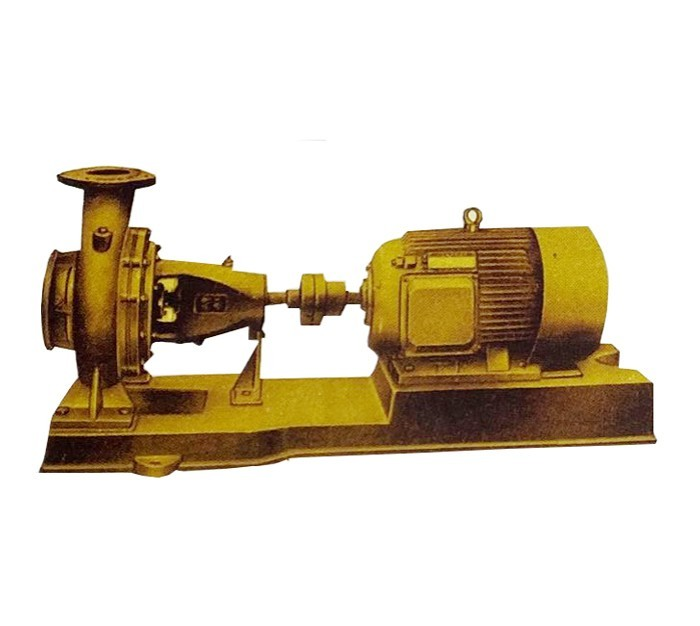
IS type pumps are generally single-stage, end suction centrifugal pumps. The suction inlet is typically axial to the impeller, while the discharge is perpendicular to the shaft. This configuration is commonly available in horizontal mounting arrangements, often on a baseplate with a coupled motor.
The operating envelope of IS type pumps usually covers moderate flow rates and moderate to high heads, depending on impeller diameter and speed. They are generally designed for clean or slightly contaminated water and similar low-viscosity liquids. Because the envelope is finite, the suitability of an IS type pump depends on whether the established duty point falls comfortably within its range, with adequate NPSH margin and acceptable efficiency.
Typical Applications for IS Type Pumps
Where the duty point aligns with their envelope, IS type pumps are commonly used in general water transfer, heating, ventilation, and air conditioning circulation, and light industrial service. They may also appear in booster and transfer duties where the required flow and head are moderate and the liquid is compatible with standard construction materials.
These application categories are general. Actual suitability depends on the specific duty point, the properties of the pumped liquid, and the applicable codes and standards for the installation.
Comparing IS Type Pumps with Other Water Pump Types
End Suction Pump vs Split Case Pump
The end suction pump vs split case pump comparison is largely a question of capacity, layout, and maintenance access. End suction pumps, including IS type, are typically compact and suitable for lower to moderate flows. Split case pumps are horizontally split, meaning the casing can be opened without disturbing the piping, and they are often used for higher flows where maintenance access to the rotor is a priority.
In terms of footprint, an end suction pump usually requires less floor space, while a split case pump may need a larger baseplate and more generous piping clearances. Head ranges also differ: split case pumps are often applied at higher capacities, whereas end suction pumps tend to serve moderate duties. When the duty point is within the end suction envelope and space is limited, an IS type pump may be adequate. When flow requirements are high or maintenance access without pipe removal is important, a split case pump may be more suitable.
Other Common Water Pump Types in Industrial and Building Services
Multistage pumps are typically used where high heads are required from a relatively compact unit, often in booster or high-rise water supply duties. Vertical turbine pumps are commonly applied in deep wells, wet pits, or where the suction source is below ground and floor space is limited. Self-priming pumps are designed to handle suction lift conditions and are often used where the pump must draw liquid from below its inlet. Submersible pumps operate submerged in the liquid and are frequently used in drainage, sump, and wastewater applications.
Each of these categories has a different relationship to duty point, layout, and maintenance. Multistage and vertical turbine designs may suit high-head or space-constrained situations, while self-priming and submersible designs address specific suction or installation conditions. The comparison remains factual and category-level; the appropriate choice depends on the project requirements.
Layout and Installation Considerations
Footprint, Piping, and Suction Conditions
Physical space often narrows the options before performance is even considered. An end suction pump typically has a smaller footprint than a split case or vertical turbine arrangement, which can be decisive in compact mechanical rooms. Suction piping is equally important: end suction configurations generally benefit from a straight suction run of sufficient length to promote stable flow into the impeller eye.
NPSH margin deserves attention in any layout. If the available NPSH is close to the required NPSH, the risk of cavitation increases, and a different pump type or a revised suction layout may be needed. Discharge routing, valve placement, and access for future service also influence how easily a given pump type can be integrated into the system.
Alignment, Foundation, and Coupling
Regardless of pump type, baseplate mounting, foundation rigidity, and shaft alignment are fundamental. A properly designed foundation reduces vibration and helps maintain alignment over time. Coupling selection should match the torque and misalignment characteristics of the application, and alignment should be checked after installation and again after the system has reached operating temperature.
These requirements are general and apply across pump categories. They are not unique to IS type pumps, but they do affect how smoothly a selected pump performs in service.
Maintenance Considerations Across Pump Types
Routine Maintenance and Wear Part Access
Routine maintenance typically includes seal inspection or replacement, bearing checks, and occasional impeller access. For IS type pumps, the back pull-out design common to many end suction configurations can allow the rotating assembly to be removed without disconnecting the suction and discharge piping, depending on the specific design. Split case pumps generally allow the casing to be opened for rotor access, which can be advantageous for larger units.
Maintenance access can influence lifecycle decisions. If a facility has limited maintenance resources or cannot tolerate extended downtime, a configuration that simplifies access to wear parts may be preferred. Conversely, if the duty point is modest and maintenance intervals are infrequent, a simpler end suction arrangement may be sufficient.
Spare Parts, Service Intervals, and Downtime Planning
Parts availability, recommended service intervals, and planned downtime are practical factors in pump selection. Standardized designs often have widely available wear parts, while specialized configurations may require longer lead times. Service intervals depend on operating conditions, fluid properties, and load profile, and should be defined in the maintenance plan.
Downtime planning involves considering whether maintenance can be performed in place or whether the pump must be removed. This consideration applies to all pump types and can affect the overall cost of ownership over the equipment lifecycle.
Decision Framework: Matching Duty Point, Layout, and Maintenance
A practical decision framework can be summarized in four steps:
- Confirm the duty point with accurate flow, head, NPSH, and efficiency figures, including corrections for altitude, temperature, and future capacity.
- Evaluate layout constraints such as available floor space, suction conditions, and piping routes.
- Assess maintenance access, including how easily seals, bearings, and impellers can be reached and how much downtime is acceptable.
- Compare IS type pumps with other water pump types against these criteria, rather than against brand or category preference.
The final choice depends on project-specific requirements and applicable codes. A pump that fits one installation may not fit another, even when the nominal duty appears similar.
Enterprise Public Information Reference
For reference only, the following details are drawn from public sources and are provided without any recommendation or promotional intent. Xuzhou Xinfeng Air Conditioning Equipment Co., Ltd is located at No. 12, Tianjin Road, Economic Development Zone, Xinyi City, Jiangsu Province. The enterprise was founded on 2002-04-29. It is recognized as a High-tech Enterprise, valid from 2024-01-04 to 2026-12-13, issued by Jiangsu Public Service Platform for SMEs, and as an Innovative SME, valid from 2024-04-25 to 2027-04-24, issued by Xuzhou MIIT Bureau. These details are verifiable public information and are included solely for reference.
Conclusion: A Requirements-Led Approach to Pump Selection
The choice between IS type pumps and other water pumps is best approached as a requirements-led decision. Duty point, layout, and maintenance considerations provide a consistent basis for comparison, while category names and brand preferences do not. By defining the duty point accurately, evaluating physical and operational constraints, and reviewing maintenance access, planners can narrow the options in a structured way.
For project-specific decisions, consulting qualified professionals is advisable, as final selection depends on the actual system, local codes, and operating conditions.