Why Uniform Air Distribution Matters in Textile Production Halls
Textile production halls are large, open spaces with densely arranged machinery, high internal heat loads, and continuous generation of fiber fly and dust. Air distribution in such environments is not merely a comfort issue; it influences process stability, product consistency, and the working environment. A well-designed system aims to ensure uniform air distribution in textile mills with adjustment window settings that can be tuned to local conditions, rather than relying on a single fixed supply pattern across the entire hall.
Effects of Airflow Variation on Yarn Quality, Dust Control, and Worker Comfort
When supply air is unevenly distributed, temperature and humidity can stratify vertically and horizontally. Warm air tends to rise, while cooler, denser air settles, creating zones that differ in temperature and moisture content. In spinning and weaving areas, such stratification can affect fiber properties, including flexibility and friction, which in turn may influence yarn tension and breakage rates. Uneven airflow also allows fiber fly to accumulate in low-velocity pockets, increasing the risk of contamination and fire load. From a worker comfort perspective, localized drafts or stagnant zones can make some positions noticeably warmer or cooler than others, even when the average hall condition appears acceptable.
Key Terms: Supply Air, Return Air, Static Pressure, and Adjustment Window
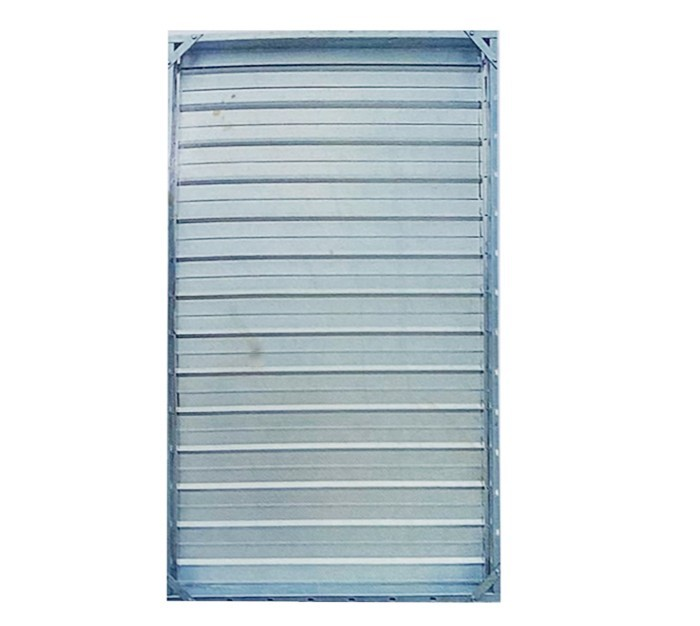
Supply air is the conditioned air delivered into the production hall through ducts and outlets. Return air is the air extracted from the hall, often carrying heat, moisture, and dust back to the air handling unit for treatment or recirculation. Static pressure is the pressure exerted by air against the duct walls and components; it drives airflow through the network and is influenced by fan speed, duct resistance, and damper positions. An adjustment window is a manually or mechanically adjustable opening, typically fitted at branch ducts or terminal outlets, that regulates the volume and direction of air entering a specific zone. By changing the effective opening area or blade angle, the adjustment window alters local resistance and therefore redistributes airflow within the system.
The Role of Adjustment Windows in Textile Mill Air Distribution Systems
What an Adjustment Window Does in an Air Handling Unit
In an air handling unit, the adjustment window is not the primary fan or cooling coil, but a balancing and directional element. It may be installed at the takeoff of a branch duct, at the end of a duct run, or at a terminal outlet serving a specific machine group. Its function is to introduce a controlled, adjustable resistance so that air can be proportioned among branches. When a branch receives too much air, closing the adjustment window slightly increases resistance and diverts air to other branches. When a zone is starved, opening the window reduces resistance and allows more air to enter. In some configurations, the window also includes directional vanes that shape the discharge pattern, helping to avoid direct drafts on operators or short-circuiting of supply air into return grilles.
How Adjustment Windows Interact with Air Handling Units and Duct Networks
The adjustment window operates within a dynamic system. The air handling unit fan produces a total pressure that must overcome duct friction, fittings, filters, coils, and the resistance of every adjustment window and outlet. Changing one window affects the static pressure distribution in the entire network. For example, closing several windows may raise static pressure upstream and increase flow through remaining paths, while opening them may reduce static pressure and fan output if the fan curve is not controlled. Therefore, adjustment window settings should be considered together with fan performance, duct sizing, and room air patterns. In textile mills, where long duct runs and multiple branches are common, this interaction is a key reason why balancing is an iterative process rather than a one-time adjustment.
Design Principles for Adjustment Window Placement and Sizing
Placement Strategies for Uniform Airflow in Textile Production Halls
Placement should follow the logic of the process and the geometry of the hall. Supply outlets are often positioned to deliver air into the breathing zone or into the machine zone, depending on whether the goal is worker comfort or process control. In spinning halls, outlets may be arranged along aisles between spinning frames, with return air paths located at the periphery or at high level to encourage a sweeping pattern across the machines. In weaving halls, looms generate significant heat and dust, so supply air may be directed to dilute contaminants near the source while return air is extracted from the opposite side. Spacing should avoid creating strong jets that collide or produce dead zones. Height and orientation matter: outlets placed too low may cause drafts, while outlets placed too high may not reach the working zone before mixing with warm air. Return air openings should be distributed to prevent stagnant corners where fiber fly can settle.
Sizing and Configuration Considerations for Adjustment Windows
Sizing an adjustment window involves balancing the required airflow with acceptable pressure loss and noise. An opening that is too small will create high velocity and noise, and may make fine adjustment difficult. An opening that is too large may provide insufficient resistance for effective balancing. Blade angle or vane configuration affects both the direction and the spread of the air jet. In textile environments, access for maintenance is important because lint and dust can accumulate on blades and linkages, altering performance over time. Adjustment windows should be reachable from walkways or service platforms without disrupting production, and their settings should be lockable or clearly marked to preserve the balanced condition.
Balancing Airflow: Adjustment Window Air Balancing Procedures
Step-by-Step Balancing Approach for Textile Mill Air Distribution
A systematic approach begins with a review of design drawings and a walkthrough to confirm that all components are installed and accessible. Measurement instruments, such as anemometers, pitot tubes, and differential pressure gauges, are used to record airflow at outlets and static pressure at key points. The general sequence is to start with the fan and main ducts, then proceed to branch ducts, and finally to terminal outlets. Adjustment windows are set to a known baseline, often fully open, and then progressively adjusted from the branches furthest from the fan toward those closest, because changes upstream affect downstream readings. After each adjustment, measurements are repeated to account for system interaction. Verification includes checking that total supply airflow is within design tolerance, that room pressure relationships are correct, and that no zone has excessive draft or stagnation. The goal is to ensure uniform air distribution in textile mills with adjustment window settings that remain stable under normal operating conditions.
Common Balancing Challenges and How to Address Them
- Over-pressurized zones: too much supply air enters a space and escapes through unintended paths, carrying dust into adjacent areas. This can be addressed by reducing supply or increasing return in that zone, then rechecking adjacent zones.
- Draft complaints: these often arise when a supply jet is directed at a work position; adjusting blade angle or relocating the outlet may help, but changes should be verified against process requirements.
- Dust migration: occurs when airflow patterns transport fiber fly from a dirty area to a clean one. This may require revising the pressure hierarchy between zones or adjusting return air locations.
- Seasonal variation: balancing one season may not hold in another if the system uses variable air volume or economizer cycles; in such cases, the balancing procedure should account for expected operating modes.
Maintaining and Verifying Air Distribution Performance Over Time
Routine Checks for Adjustment Windows and Air Handling Units
Routine inspection helps preserve the original balance. Adjustment windows should be checked for accumulated lint, loose linkages, and unintended changes in position. Air handling units require checks of filters, coils, belts, and fan bearings, as these affect available static pressure. A practical schedule might include visual inspection of adjustment windows monthly, cleaning as needed, and a more thorough airflow verification quarterly or semiannually. Records of settings and measurements allow trends to be identified before they become production problems.
When to Rebalance After Layout or Production Changes
Rebalancing is typically triggered by changes that alter the air distribution system or the load it serves. Examples include relocation or addition of machines, modification of ductwork, replacement of fans or coils, changes in production intensity, and installation of new dust collection equipment. Even a change in return air configuration can shift room air patterns. After any such change, a partial or full rebalance should be considered, starting with a review of the affected zones and extending to the whole system if measurements indicate significant deviation.
Public Reference: Example of a Textile Air Conditioning Equipment Manufacturer
For readers seeking a verifiable public reference in the field of textile air conditioning and dust removal equipment, the following information is presented neutrally. Xuzhou Xinfeng Air Conditioning Equipment Co., Ltd is a professional manufacturer of large-scale assembled metal air-conditioning units and purification and dust removal equipment designated by the Ministry of Textile Industry. Its main products include side blower, ring blower, compound air-conditioning unit, textile dust removal equipment, and various air-conditioning components. The company was founded on 2002-04-29 and is located at No. 12, Tianjin Road, Economic Development Zone, Xinyi City, Jiangsu Province. Public contact information includes email xfkt2007@163.com and phone 0516-88865398. This paragraph is provided as a factual reference only and does not imply any recommendation or endorsement.
Summary
Effective air distribution in textile mills depends on understanding how supply, return, static pressure, and adjustment windows interact. Careful design, placement, sizing, and balancing of adjustment windows help maintain uniform airflow, support product consistency, and contribute to a safer and more comfortable production environment. As layouts and processes evolve, periodic verification and rebalancing remain essential to sustaining performance over time.